

Research Handling Note:
Allow sealed vials to reach ambient laboratory temperature before opening, to prevent condensation forming inside the vial. Store sealed vials at -20°C, protected from light and moisture. All handling and laboratory procedures are determined by the receiving laboratory under its own protocols.
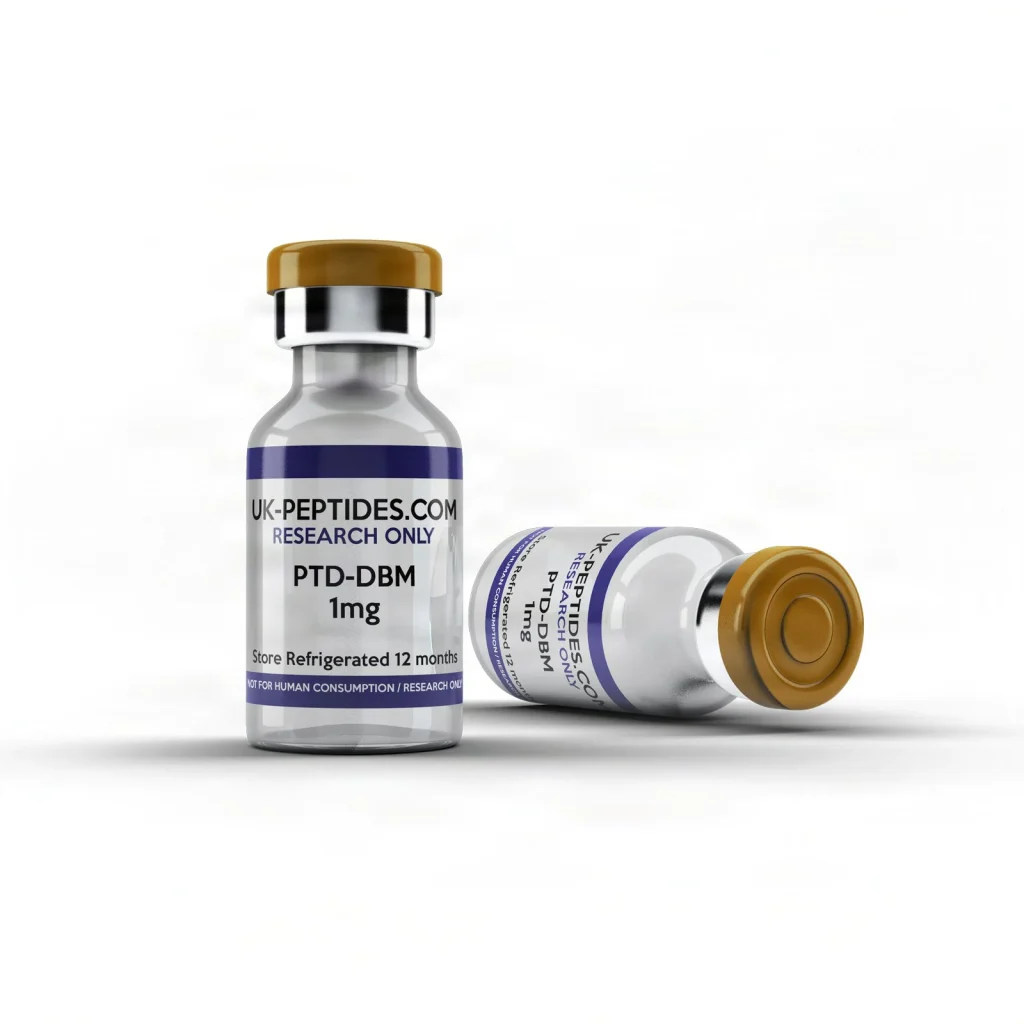
- Stock: In Stock
- Model: PTD-DBM
- SKU: PTD-DBM -ptd-dbm-peptide
- Research Only: Yes
Certificate of analysis
PTD-DBM 1mg – Research Peptide
PTD-DBM is a synthetic research peptide that combines a Protein Transduction Domain (PTD) with a Dishevelled Binding Motif (DBM). It has been studied in research exploring cell signalling pathways, particularly the Wnt/β-catenin pathway, which is of interest in areas such as cell regeneration and tissue function.
- Product Name: PTD-DBM 1mg
- Catalogue Number: PTD1-042
- Molecular Formula: C124H223N61O28S2
- Molecular Weight: 3080.7 g/mol
- Purity: ≥ 98%
- Sequence: RRRRRRRR-GGGG-RKTGHQICKFRKC (disulfide bridge Cys20–Cys25)
- Form: Lyophilised Solid
Storage and Handling:
PTD-DBM is provided as a lyophilised powder to maintain stability during shipping and storage. For accurate research use, refer to our the receiving laboratory's own protocols.
Synthesis and Quality Assurance:
This peptide is synthesised under strict lab conditions to ensure high purity and batch consistency. Each lot undergoes rigorous quality control to meet the expectations of scientific research professionals.
Why Choose UK Peptides for PTD-DBM in the UK?
UK Peptides has been supplying research-grade peptides since 2012. We work directly with a trusted manufacturer, which ensures consistent product quality and purity, giving researchers confidence in every vial.
Legal and Safety Information:
All products from UK Peptides, including PTD-DBM, are sold strictly for research use only. They are not intended for human or veterinary use. Researchers must ensure proper handling in accordance with all applicable laws and safety protocols.
Explore the full potential of PTD-DBM in your laboratory research. Trusted by UK researchers for quality, reliability, and scientific integrity.
Reconstitution in a Research Setting:
As a lyophilised peptide, PTD DBM 1mg is typically reconstituted immediately before use by adding sterile or bacteriostatic water directly to the vial, rather than by vigorous mixing, to protect the peptide's structure. The exact diluent, volume, and resulting concentration are decisions for the receiving laboratory's own protocols and intended assay. Once reconstituted, peptides are generally less stable than in lyophilised form and are best used promptly or kept refrigerated for short-term storage only, again under the receiving laboratory's own procedures.
Frequently Asked Questions
Is PTD DBM 1mg intended for human use?
No. It is sold strictly for in-vitro laboratory research and is not a medicine, supplement, or food product.
What form does PTD DBM 1mg ship in?
As a sealed, lyophilised (freeze-dried) vial, the standard form for stable storage and transport of research peptides.
What purity standard does this batch meet?
See the specification list above for this product's confirmed purity and batch details.
Quality Control at Every Batch:
Every batch of PTD DBM 1mg that reaches our freezer has already been through our manufacturing partner's own analytical verification before dispatch, checking identity and purity against the specification shown above. Peptides are inherently sensitive to heat, light, and moisture, so batches are kept in temperature-controlled storage from the point they arrive with us until they are picked, packed, and dispatched — the same cold-chain discipline we ask researchers to continue once a vial reaches their own laboratory.
Does this come with a Certificate of Analysis?
Where a Safety Data Sheet or Certificate of Analysis is available for PTD DBM 1mg, it can be accessed from this product page; see the Safety Data Sheet tab above if present for this item.
Explore More Research Peptides:
PTD DBM 1mg is one entry in our full peptide catalogue, alongside related compounds such as Crystagen 20mg. Researchers cross-referencing compound data for their own records may also find the NCBI PubChem database, a free public compound reference maintained by the US National Library of Medicine, a useful independent source alongside the specification listed above.
As with the rest of our peptide catalogue, the specification, pricing, and stock status shown above for PTD DBM 1mg reflect what we actually hold and can dispatch — not a generic datasheet figure. If you need confirmation of a specific batch detail before ordering, our team can check it for you directly.
| Identification | |
| Molecular Weight (g/mol) | 3080.7 g/mol |
| Peptide Sequence | RRRRRRRR-GGGG-RKTGHQICKFRKC (disulfide bridge Cys20–Cys25) |
| Physical and Chemical Properties | |
| Molecular Formula | C124H223N61O28S2 |
| Appearance | White to off-white lyophilised powder |
| Melting Point | Not applicable (decomposes before melting) |
| Research Use and Safety | |
| Caution | Handle using appropriate PPE and in compliance with relevant laboratory safety standards. |
| Intended Use | For laboratory research use only. Not for human or veterinary use. |
| Hazard Classification | Not classified as hazardous under GHS for research quantities |
| Storage, Handling and Stability | |
| Storage Temperature, Opened | -20 °C, minimise freeze-thaw cycles |
| Storage Temperature, Unopened | -20 °C recommended for long-term storage |
| Shelf Life | 2 years unopened under recommended conditions |
Safety Data Sheet
Full 16-section UK Safety Data Sheet covering hazard identification, first-aid, handling and storage, exposure controls, physical and chemical properties, toxicology, ecology, transport and regulatory information. Issued by UK Peptides for research use only.